The AI thatis built onyour data.
Karma is not a chatbot bolted onto an HR system. It reads across every module — organisation, absence, payroll, recruitment, feedback and learning — because they are one dataset rather than six.
Adds a talking point to their next 1:1Approve
How it works
Ask in plain language. Karma prepares the work.
Any question about your people, in your own words. No report builder, no filters. Karma pulls the data, drafts the change and waits for a person to say yes.
Choose a question…
AI as the operating layer
Not a feature. The layer underneath everything.
Most HR tools add AI to a single screen. In Komma, Karma sits on the same live employee record that every module reads from — so it sees the whole picture and can act across all of it in one draft.
Human in the loop, by design
Karma drafts. You approve. Everything is logged.
Karma pulls the data, drafts the change and shows you exactly what will happen — field by field — before anything is written to your HR system.
- ReadsKarma pulls what it needs from the live employee record — within the access of the person asking.
- DraftsIt prepares the change across every module the request touches.
- ShowsYou see exactly what will change, field by field, before anything is saved.
- Waits for youNothing is written until a person approves. The approval, and what was changed, goes on the audit log with their name.
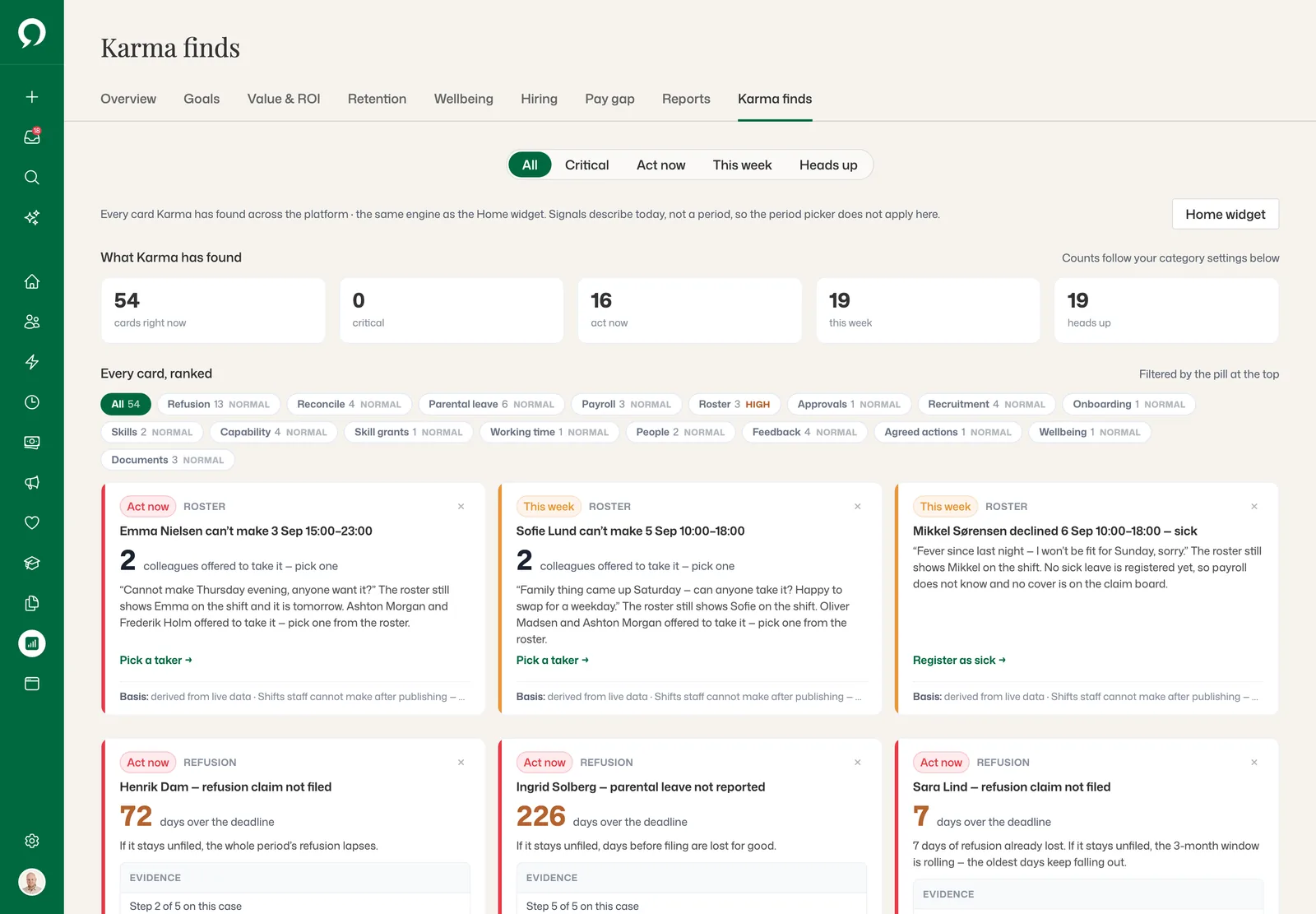
- 2Two colleagues offered to take the shift. Karma lines them up; a person picks.
 12
12- 1All 54 cards, ranked across the platform: reimbursement, payroll, roster, recruitment and more.
- KarmaEach card states its basis: derived from live data.
- KarmaMikkel declined sick, but no sick leave is registered, so payroll does not know yet.
Across the platform
What Karma does in each module.
The same assistant, working on whatever the module in front of you is about.
Karma in Recruitment
Point at a match and Karma explains it.
Karma reads the job ad, proposes the skills the role needs and how much each one counts, and scores every candidate against them. Hover a match and the reasoning is there, criterion by criterion.
- Requirements, skills, experience, motivation and culture fit, each weighted by importance
- Marked as AI-generated, with a reminder to review it
- Who moves on is decided by people
 1
1- KarmaEach criterion scored and explained, weighted by importance.
- 191 % job match. The shortlist starts from facts.
- KarmaAI-generated, and it says so. People decide.
Karma on mobile
In the pocket of the people on shift.
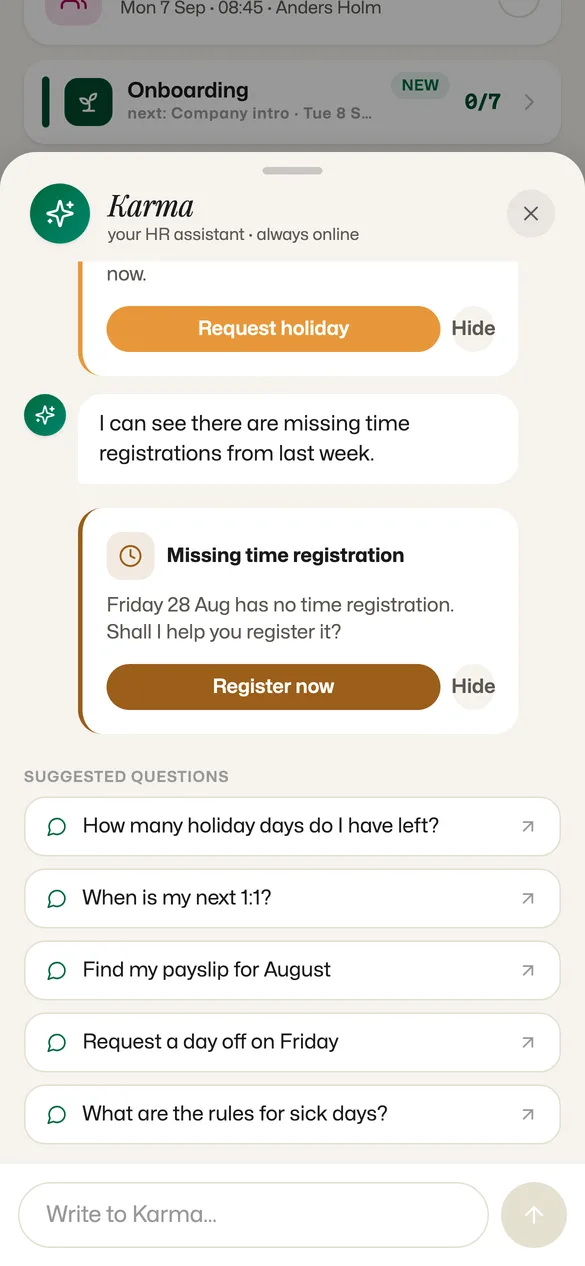
Most employees will never open the desktop. On the phone Karma notices what is missing, suggests the questions people actually ask, and takes them to the right screen.
- A missing registration, caught before it reaches payroll
- Holiday left, the next 1:1 or last month’s payslip — one question away
- The same rule: Karma prepares, the person confirms
 1
1- KarmaKarma sees a missing registration for Friday and offers to fix it.
- 1Suggested questions: holiday left, the next 1:1, the August payslip.
Karma and your data
The AI is an assistant, not a decision-maker.
There are good reasons to be sceptical about AI in HR. Here is what we do about them.
- No automated decisionsKarma suggests and ranks. Hiring, pay, warnings and dismissals are decided by people — and that is not a setting you can switch off.
- Everything is traceableEach suggestion is logged with what Karma proposed, what was changed, and who approved it.
- Your data does not train anyone else’s modelsKarma works on your own dataset. The content is not used to train models that benefit other customers.
- Access follows rolesRole-based access and SSO through Microsoft Entra. Karma works within the permissions of the person asking.
- European by designHosted in the EU and built for GDPR, with transparency and human oversight in every AI feature.
- It can be switched offKarma can be disabled per module, if you would like it in recruitment but not in payroll processing.
Built for the Nordics
Made for how Nordic HR actually works.
Collective agreements, supplements and the payroll engine you already trust. Komma owns everything gross — and hands over a validated pay run.
Where Karma is heading
Two tracks. One rule.
We are widening Komma across more of HR, and teaching Karma to carry multi-step workflows. What does not change: Karma drafts, people decide. The roadmap describes direction, not delivery dates.
FAQ
What HR teams ask about Karma.
Does Karma change anything on its own?
No. Karma drafts the change and shows you exactly what will happen, field by field. Nothing is saved until a person approves it, and every approval is recorded in the audit log with that person’s name.
What can Karma do today?
Karma parses CVs into scored skills, drafts job ads, suggests shift coverage, summarises evaluations and spots absence patterns — with the same approve-first rule everywhere.
Is our data used to train AI models?
Karma works on your own dataset. The content is not used to train models that benefit other customers.
Where is our data stored and processed?
In the EU. Komma is built for Nordic organisations, with GDPR as the baseline for every AI feature.
Who can see what Karma sees?
Karma works within the role-based access of the person asking — if you can’t see salaries, neither can Karma when it works for you. Sign-in runs through Microsoft Entra SSO.
Can we switch Karma off?
Yes, per module. You can use it in recruitment but not in payroll processing, for example.
Does Komma replace our payroll system?
No. Komma owns everything gross — pay components, collective-agreement rules, time-to-supplement valorisation and pre-payroll validation. The gross-to-net calculation, A-skat, AM-bidrag, eIndkomst and payslips stay with your payroll engine: Zenegy, Danløn, Dataløn, Visma, Lessor or Intect.
Ask it something on your own data.
The quickest way to judge Karma is to put a real question to it against your own org structure.